By Victor V Rao MBBS, DMRD, RDMS
Introduction
A hypothetical question – Given the constraints of training time, if a critical care fellow could attain mastery in only one POCUS skill set, which would confer the greatest diagnostic and therapeutic benefit to critically ill patients, which POCUS skill set would it be?
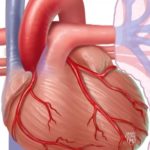
Extensive data research results indicate that every major society converges on the same answer: focused cardiac ultrasound (FoCUS) for the undifferentiated hypotensive/shock patient specifically, qualitative left ventricular (LV) function, right ventricular (RV) size/strain, pericardial effusion/tamponade physiology, and IVC assessment.
Lung ultrasound (pneumothorax, pulmonary edema, consolidation, effusion) was identified as the only real competitor for the number one slot and is taught as its inseparable partner, and not a substitute. Together they form the cardiopulmonary core skills of every shock/arrest protocol (RUSH, FATE, CAUSE, SHoC).
Interestingly, no guideline formally ranks the above-mentioned skill sets as #1 versus #2. The case for naming FoCUS the single most important skill set rests on four converging lines of evidence below. The case for lung ultrasound as the easiest, fastest-to-learn, single highest accuracy skill set is presented later in this blog article, so you can decide which framing fits your practice goals.
Why FoCUS/Critical Care Echocardiography is Named the Top Skill set for Critical Care Clinicians
1. It is the largest single competency domain in core CCUS training standards
The Mayo et al. international consensus on core critical care ultrasound competencies (Critical Care, 2020, endorsed by multiple critical care societies) lists 15 echocardiographic competencies versus 5 thoracic, 4 abdominal, and smaller vascular/DVT domains. Echocardiography is the single largest and most heavily weighted skill category in formal CCUS curricula.
2. It is the backbone of every composite shock/arrest protocol
RUSH (“Pump, Tank, Pipes”), FATE, CAUSE/SESAMI, and SHoC all put cardiac assessment first and it is the initial branch point that determines whether the patient has obstructive, cardiogenic, hypovolemic, or distributive shock, which then dictates every downstream ultrasound and treatment step.
3. It has the best-documented direct effect on real-time patients’ management change
Focused echocardiography studies in ICU patients report a change in management in roughly 35–51% of scans. Most commonly alterations to fluid therapy and vasoactive drug choice.
4. Every relevant guideline body grades it as strong/high priority
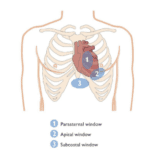
- ESICM 2021 “head-to-toe” basic ultrasound consensus (Robba et al., Intensive Care Medicine, 19 intensivists/10 countries) gives strong-in-favor recommendations for: Classifying LV systolic function from 4 standard windows, RV size/dilation to rule obstructive shock in/out, pericardial effusion/tamponade physiology, and severe-hypovolemia recognition via IVC + collapsing ventricles.
- ACEP/ASE Focused Cardiac Ultrasound Consensus Statement defines FoCUS as central to resuscitation: pericardial effusion/tamponade guidance for pericardiocentesis, qualitative LV function, RV strain in suspected massive PE, IVC-based volume estimate, and distinguishing true PEA from pseudo-PEA during cardiac arrest.
Lung POCUS as “highest yield” by Evidence Grade and Learning Curve
If high yield is defined strictly by GRADE-level diagnostic evidence and speed of skill acquisition rather than downstream management impact, lung ultrasound has the edge:
- The WINFOCUS/International Liaison Committee on Lung Ultrasound (ILC-LUS) 2012 consensus (28 experts, 8 countries, published in Intensive Care Medicine) reached Level A/B, strong-consensus grading for pneumothorax detection (lung sliding/B-lines/lung point), interstitial syndrome, consolidation, and pleural effusion as the single most robustly GRADE-graded application set in all of POCUS.
- Lung ultrasound for pneumothorax has reported sensitivity approximately 92% vs. supine CXR and is faster to teach to novices than echocardiographic window acquisition.
- ESICM 2021 also rates the core lung applications strong-in-favor.
- The POCUS25 research study also indicated that lung ultrasound was the number one POCUS clinical skill recommended by POCUS users from around the world.
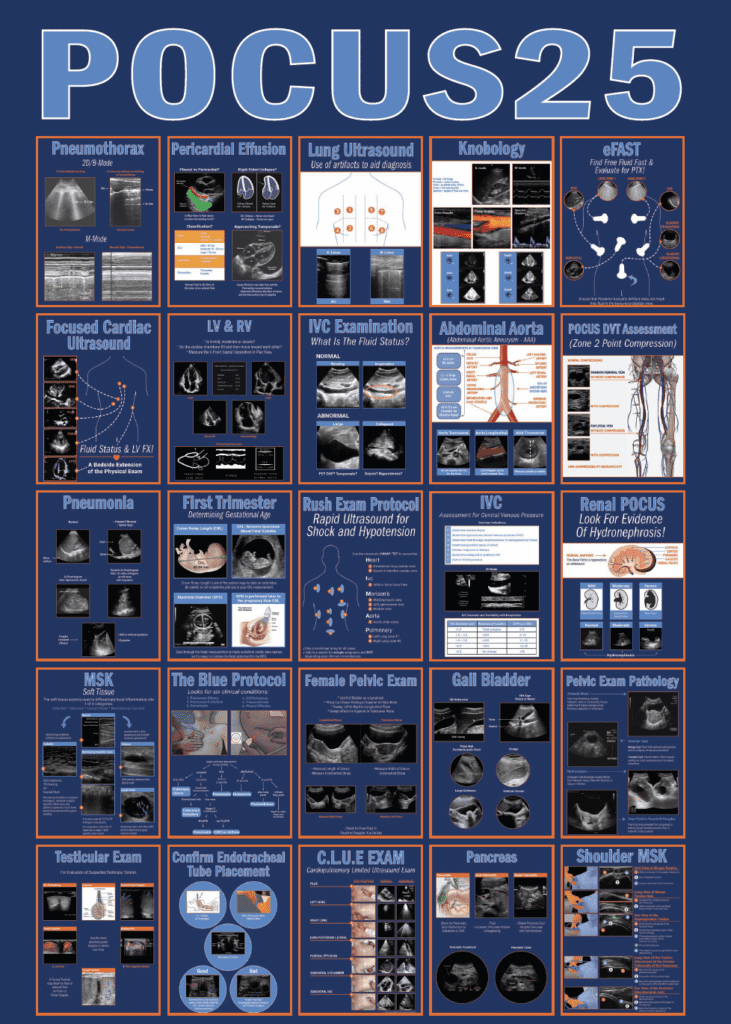
Figure 1. Screenshot of the POCUS25 poster. You may access and download the full poster in high resolution here. This may be a useful source for POCUS learners. To learn about the individual 25 POCUS practice domains, click here.
Final Thoughts
No formal cross-application ranking exists. We can consider FoCUS is #1 skill set as an evidence-synthesized judgment, not a stated guideline ranking. FoCUS RV findings in suspected massive PE have limited sensitivity (29–56%) depending on the sign used and cannot rule out PE alone.
ESICM explicitly recommends not using ultrasound alone (IVC/ventricular size) to test fluid responsiveness in persistent shock without signs of hypovolemia. Critical care fellows or physicians/clinicians managing critically ill patients must ideally learn cardiac and lung ultrasound as a paired first module.
This is what SCCM, ESICM, ACEP/ASE, and WINFOCUS collectively support but if forced to pick a single skill set with the greatest effect on immediate management decisions (fluids vs. pressors vs. pericardiocentesis vs. thrombolysis) in the critically ill, undifferentiated patient, FoCUS is the better-justified answer based on the competency-weighting, protocol-centrality, and change-in-management evidence above.
This article is meant to give critical care providers clarity on which POCUS skill sets deserve priority. POCUS users may form their own priorities based on the patient population they serve. In my view, critical care clinicians should aim to master both skill sets. Incorporating lung ultrasound is not a substantial additional burden, as it carries a relatively short learning curve. The payoff, however, is considerable and will provide the clinician with a much clearer, real-time understanding of the patient’s underlying pathophysiology.
References
- https://doi.org/10.1186/s13054-020-03099-8
- https://u-picardie.hal.science/hal-03584064v1
- https://pubmed.ncbi.nlm.nih.gov/39982182/
- https://www.acep.org/siteassets/uploads/uploaded-files/acep/by-medical-focus/ultrasound/acep_ase_card_us_stmt_sep10.pdf
- http://handsonecho.com/sites/53072f21c97d797504000002/content_entry530f3ce3c97d79b7c2000279/5470d9fdc97d7904e30d4fdc/files/Consensus_LUS.pdf
- https://doi.org/10.1177/1751143717700911
- https://www.acep.org/sonoguide/advanced/rush
- https://doi.org/10.29252/beat-060402
- https://blogs.cardiff.ac.uk/bmccu/wp-content/uploads/sites/345/2016/06/Tutorial-9-Lung-ultrasound-%EF%80%A7-ICU-Sonography.pdf
*Disclaimer
AI (Perplexity Pro) was used to conduct extensive research on this topic, draft the outline and help identify the most important POCUS skill set to learn to manage patient’s undergoing critical care management. The author has reviewed, verified and edited the content for accuracy and relevance to POCUS primary care. Some views are the author’s own views but are based on consensus of the medical community and personal POCUS experience.
Was this learning resource valuable?
Access the full POCUS Learning Library for FREE!
Share a few details so we can tailor new content to your specialty and region.