By Victor V Rao MBBS, DMRD, RDMS
Introduction
Point-of-care cardiac ultrasound in primary care can improve the cardiac examination for diagnosis, risk stratification, and triage, provided it is implemented within a defined scope, training, and governance framework.
Recent consensus statements and accuracy studies support basic or focused cardiac POCUS by primary care clinicians for detecting left or right ventricular dysfunction, mitral stenosis, aortic stenosis, rheumatic heart disease, pericardial effusion, cardiac tamponade, and volume status related abnormalities, with growing guidance on proper nomenclature, documentation, and integration into outpatient workflows.
Scope in Primary Care
Cardiac POCUS in primary care refers to a focused or “limited” cardiac ultrasound examination performed at the bedside to answer specific binary questions (for example, “Is LV function significantly reduced?” or “Is there a pericardial effusion? Or is the patient in cardiac tamponade”, rather than a full consultative echocardiogram.
Even though some POCUS experts may perform detailed echocardiography, that may not be the case for all POCUS users. The clinician typically uses a handheld or compact ultrasound device with immediate interpretation that directly impacts same-visit management and referral decisions.
Key Primary Care Appropriate Questions
- Does the patient have significantly reduced LV systolic function?
- Is there moderate–severe valvular disease likely to explain symptoms?
- Is there pericardial effusion or cardiac tamponade physiology?
- Is right ventricular dilation present in a patient with dyspnea with clinical suspicion of pulmonary embolism (PE)?
- Is there evidence of volume overload (cardiogenic pulmonary edema, raised right‑sided pressures) or marked hypovolemia?
Evidence Base and Diagnostic Performance
A 2023–2024 multispecialty review concluded that cardiac POCUS, when performed by trained clinicians, shows high diagnostic accuracy for global LV function, significant pericardial effusion, right ventricular enlargement, and gross valvular lesions, with strong concordance to standard echocardiography for these focused indications.
A large emergency‑department meta-analysis found pooled sensitivity and specificity around 88–90% for ultrasound diagnosis of acute heart failure via lung and cardiac findings, exceeding physical examination alone for pulmonary edema and volume status assessment.
In primary care specifically, a recent prospective study of AI‑assisted Focused Cardiac Ultrasound (AI‑FOCUS) in 1,780 patients showed 94.33% overall diagnostic accuracy, 89.91% sensitivity, and 96.49% specificity for detecting LV ejection fraction less than 50%, screening-level valvular abnormalities, and pericardial effusion compared with cardiologist‑performed echocardiography (κ = 0.88). AI‑FOCUS particularly enhanced detection of systolic dysfunction and valvular disease that would otherwise have required later specialist imaging, supporting its role in early detection and triage in the primary care setting.
Practical Cardiac Applications in Primary Care
1. Heart Failure and Dyspnea Assessment
Cardiac POCUS can visually categorize LV function (normal, mildly, or severely reduced), identify chamber enlargement, and combine with lung ultrasound B‑line assessment to differentiate cardiac from non‑cardiac dyspnea. In outpatients with breathlessness, detection of diffuse B‑lines plus reduced LV function or dilated IVC increases the likelihood of heart failure and justifies expedited cardiology referral and early initiation or intensification of guideline‑directed therapy.
Typical primary‑care use cases include new exertional dyspnea or orthopnea where natriuretic peptide testing or echo access is delayed. Follow‑up of known heart failure to assess congestion alongside weight, blood pressure, and symptoms. Distinguishing COPD/asthma from cardiac causes when examination and chest X‑ray are equivocal can be lifesaving at times.
2. Valvular Heart Disease Screening
AI‑assisted and focused POCUS protocols can detect screening‑level valve pathology (for example, moderate–severe aortic stenosis, significant mitral regurgitation) by integrating color Doppler and AI‑guided measurements. In the AI‑FOCUS primary care study, valvular disease constituted 42% of confirmed abnormalities, indicating a substantial burden of previously unrecognized disease in community populations.
Primary care roles include screening older patients with systolic murmurs, syncope, exertional dyspnea, or heart failure symptoms. Risk stratifying patients with known mild valvular disease who develop symptom progression and prioritizing cardiology referral based on POCUS evidence of significant valve lesions.
3. Pericardial Effusion and Cardiac Tamponade
Cardiac POCUS is highly sensitive in identifying mild, moderate and large pericardial effusions and can demonstrate right ventricular diastolic collapse or significant respiratory variation of transvalvular flow (across the tricuspid and mitral valves), supporting cardiac tamponade physiology. In primary care, this is especially relevant for patients with unexplained hypotension, tachycardia, and dyspnea.
Patients with known malignancy, autoimmune disease, or recent cardiac surgery presenting with chest discomfort or reduced exercise tolerance. While definitive management occurs in hospital, rapid recognition in the clinic can lead to immediate intervention or transfer of the patient with clearer pre‑arrival diagnosis to avoid unnecessary delay in appropriate management.
4. Right Heart and Pulmonary Embolism (PE) Risk
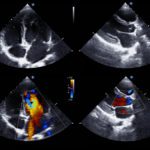
Cardiac POCUS can identify right ventricular enlargement and interventricular septal flattening, which, in the correct clinical context, raise suspicion for hemodynamically significant PE and guide emergency referral. In primary care, this is an adjunct to clinical prediction scores and D‑dimer testing; a “grossly abnormal” right ventricle on a patient with high pretest probability should prompt urgent emergency department (ED) transfer rather than outpatient workup.
5. Volume Status and Blood Pressure Management
Assessment of IVC diameter and collapsibility, combined with cardiac and lung findings, can help distinguish hypovolemia from cardiogenic shock or hypertensive cardiac failure, supporting diuretic titration or cautious fluid administration in complex chronic disease patients. In outpatient settings, serial POCUS can contribute to managing resistant hypertension, advanced chronic kidney disease (CKD), or heart failure where small changes in volume status significantly affect symptoms and risk.
Guidelines, Nomenclature, and Training Standards
Nomenclature and Examination Levels
The 2024 American Society of Echocardiography (ASE) recommendations for cardiac POCUS and ultrasound‑assisted physical examination provide detailed nomenclature and scope definitions.
Basic Cardiac POCUS
Limited, problem‑oriented examination using primarily B‑mode imaging (and often color Doppler) to answer focused questions on global function, pericardial effusion, and gross valvular disease, appropriate for primary care with structured training.
Advanced Cardiac POCUS / Critical Care Echocardiography
Comprehensive hemodynamic and structural assessment (multiple measurements, Doppler quantification), generally reserved for more specialized training environments. The statement emphasizes that cardiac POCUS should be considered separate from consultative transthoracic echocardiography, with different documentation, reporting, and quality expectations, but still subject to governance for patient safety.
Implementation in Outpatient and Family Medicine Settings
A recent 2024 clinician guide outlines a framework for integrating POCUS into outpatient practice, emphasizing needs assessment, protocol selection, equipment, training, and quality assurance. Steps include identifying clinical scenarios where POCUS will regularly affect decisions (for example, dyspnea, chest pain, syncope, edema). Choosing standardized cardiac and lung POCUS protocols compatible with available devices and guidelines. Establishing documentation templates and image archiving policies that differentiate focused from comprehensive exams. Embedding quality review, certification, credentialing, and maintenance of competence (MOC) with periodic image review by experienced sonographers.
In family medicine residencies, POCUS curricula now routinely incorporate cardiac applications, with evidence of growth in training resources and scope over the past 5 years. Curriculum guidelines suggest progressive milestones: image acquisition of basic cardiac views, qualitative assessment of LV function, recognition of pericardial effusion, and integration with clinical reasoning.
Workflow Integration, Documentation, and Limitations
Cardiac POCUS fits best when integrated as a targeted extension of the history and physical examination, rather than as a stand‑alone imaging test. In primary care, this often means predefining which conditions trigger a POCUS examination (for example, new onset dyspnea with elevated risk factors) and ensuring that each study has a clear clinical question documented.
Guideline‑aligned Documentation for Cardiac POCUS
Every hospital or clinic may formulate their own guidelines for documentation based on the patient population they serve. However, there are some general guidelines that must be kept in mind when addressing documentation of cardiac POCUS findings.
- Indications for the cardiac POCUS examination.
- Focused clinical question. (Example – Is there a pericardial effusion? Is the patient in cardiac tamponade? Is LV systolic function normal or reduced?)
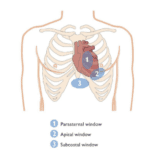
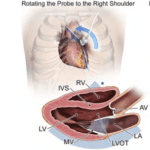
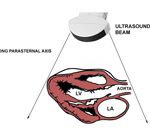
- Protocol used and views obtained (Parasternal long axis view, parasternal short axis views, apical four‑chamber view, subcostal and suprasternal notch view).
- Qualitative findings (Global LV systolic function, gross valvular abnormalities, pericardial effusion, cardiac tamponade physiology, chamber sizes, IVC).
- General statement on image quality and limitations (if any).
- Patient management (Example – Immediate intervention, immediate ED/cardiology referral, urgent full echocardiography, medication change, or routine follow‑up).
Limitations and Safeguards
POCUS should not be used to “rule out” complex structural heart disease or subtle valvular pathology as normal findings do not replace a formal echocardiography study performed in a dedicated echocardiography department. Be aware that the POCUS devices may have image resolution limitations and in the case of valvular abnormalities, it is highly recommended to perform a transesophageal echocardiography to obtain high resolution images which may not be possible with a transthoracic approach.
Operator dependency remains a substantial factor, although AI‑assisted images acquisition and interpretation can mitigate this limitation and has shown high accuracy in primary care cohorts. Governance structures (certification, credentialing, continuing medical education (CME), regular image review) are needed to prevent over‑confidence and diagnostic errors. If you ever doubt, do not hesitate to refer the patient for a full echocardiography study and a cardiology consultation.
Final Thoughts
Currently commercially available POCUS devices provide acceptable image quality for focused cardiac assessment and can integrate AI guidance for optimal image acquisition and automated LV function or valvular assessment, which enhances feasibility in patient healthcare environment. Device manufacturers and academicians are increasingly targeting primary care image optimization and acquisition, synchronized workflows, integrating image and video archiving, structured reporting, and decision process to standardize use in the clinical arena.
Future directions highlighted in recent reviews include expanding AI‑assisted FoCUS into preventive cardiology, using serial focused scans to monitor cardiac “biologic age,” detect subclinical valvular disease and ischemic heart disease, and refine cardiovascular risk stratification beyond traditional factors.
As the evidence base grows, primary care–specific competency frameworks and reimbursement models are likely to become more formalized, facilitating broader adoption with consistent quality and safety. Even though some POCUS users may consider cardiac POCUS challenging, I would encourage you to take basic steps to master the basic echocardiography views and learn pattern recognition of common conditions that you encounter in your patient population and perform prospective echography examination before referring the patient for a full assessment in an echocardiography lab and then compare the results to validate your findings.
With time you will start developing a higher level of confidence as you observe that your findings are consistent with the official echocardiography report by a cardiologist. Take a moment to review the references provided below for an even deeper dive into this topic. My goal is that every clinician around the world will add cardiac POCUS to their list of skills to learn, so more lives can be saved, and we can deliver best cardiac care to our patients and improve our patients’ quality of life.
References
- ASE Recommendations for Cardiac Point‑of‑Care Ultrasound and Ultrasound‑Assisted Physical Examination, 2024. https://www.asecho.org/wp-content/uploads/2025/04/PIIS0894731724002220-2024-POCUS-Nomenclature.pdf
- A Review of Cardiac Point‑of‑Care Ultrasound Across Specialties, American Journal of Cardiology/related journal, 2023 https://www.amjmed.com/article/S0002-9343(23)00158-4/fulltext
- Diagnostic Accuracy of AI‑Assisted Focused Cardiac Ultrasound in Primary Care, large prospective study, 2025 https://pmc.ncbi.nlm.nih.gov/articles/PMC12610991/
- AI‑Assisted Focused Cardiac Ultrasound in Preventive Cardiology, Nature Portfolio review, 2025 https://www.nature.com/articles/s44325-025-00063-9
- The Rise of Point‑of‑Care Ultrasound in Cardiopulmonary Diagnostics, 2025 review of cardiovascular and pulmonary applications https://pmc.ncbi.nlm.nih.gov/articles/PMC12756059/
- A Clinician’s Guide to the Implementation of POCUS in Outpatient Practice, 2024. https://journals.sagepub.com/doi/10.1177/21501319241255576
- Family Medicine POCUS training and curriculum guideline documents (AAFP and residency‑based studies, 2020–2025 https://kaweahem.com/wp-content/uploads/2019/04/AAFP-POCUS-Curriculum.pdf
*Disclaimer
AI (Perplexity Pro) was used to conduct deep research on this topic and draft the outline. The author has reviewed, verified and edited the content for accuracy and relevance to cardiac POCUS. Some views are the author’s own views but are based on consensus of the medical community. By no means are POCUS users being discouraged to learn more cardiac POCUS skills beyond what are mentioned in this blog article.
Access the full POCUS Learning Library for FREE!
Share a few details so we can tailor new content to your specialty and region.