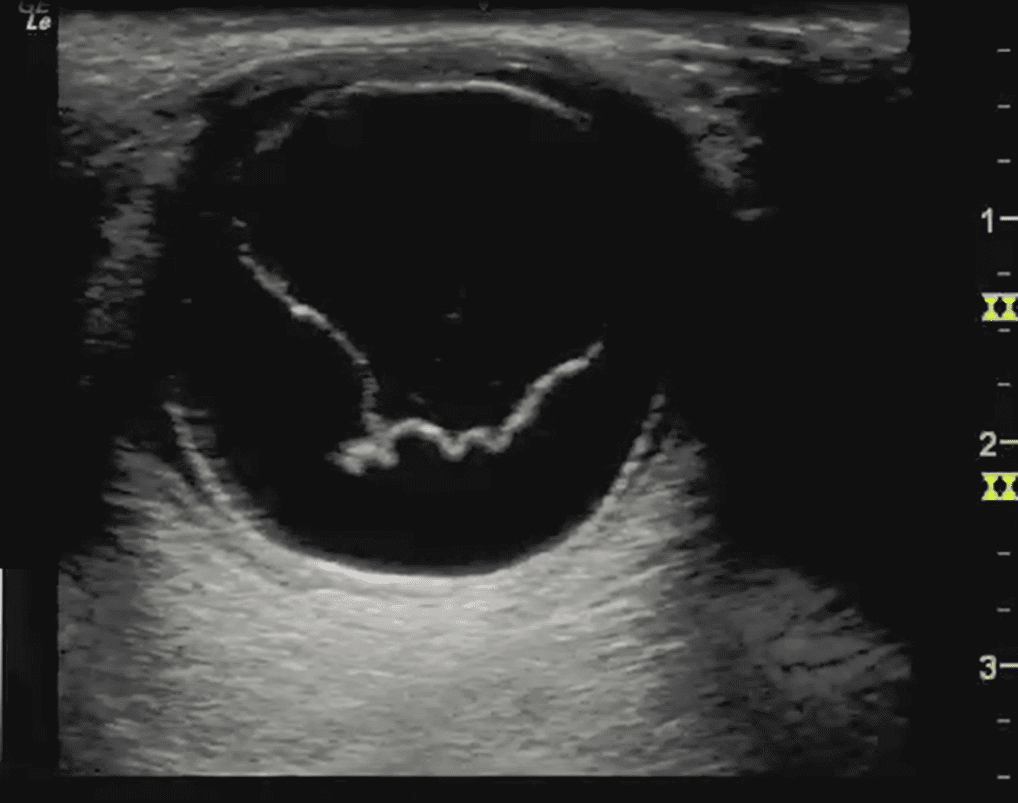

A 67-year-old male patient came to the Emergency Department with a history of loss of vision in one eye. The patient did not complain of any pain in the affected eye. There is no history of trauma or injury to the eye. He does have a history of Myopia since childhood. He is also a known hypertensive but does take antihypertensive medication regularly. An ultrasound exam was performed on the affected eye using the ophthalmology preset. The following view was obtained.
What is the diagnosis?
A. Foreign body in the eye
B. Vitreous hemorrhage
C. Displaced intraocular lens
D. Retinal detachment

The diagnosis is retinal detachment.
Explanation
On ocular ultrasound, retinal detachment appears as a relatively thick, echogenic membrane that remains anchored to the optic disc and ora serrata. Posterior vitreous detachment appears thinner, membrane like, often crosses over the optic nerve (not attached to the optic disc) shows pronounced “aftermovement” with eye motion.

Figure 1. Diagrammatic representation of retinal detachment. Note that the retina stays attached to the optic disc.

Figure 2. Retinal detachment. Observe that the retina is attached to the optic disc. This finding is very important to make the correct diagnosis. Image courtesy of Emory University School of Medicine.
Access the full POCUS Learning Library for FREE!
Share a few details so we can tailor new content to your specialty and region.