A 28-year-old man presented to the emergency department with 7 days of fever, severe abdominal pain, and abdominal distension after recent travel to Haiti for a humanitarian project. He had taken antacids without relief, denied trauma, had no significant past medical history, and was not on any regular medications.
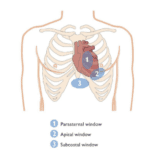
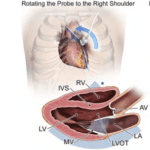
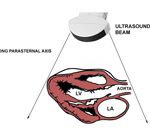
On examination, he was lethargic, febrile to 102°F (38.9°C), with blood pressure 140/88 mmHg, oxygen saturation 98% on room air, and a slightly distended abdomen with rebound tenderness. A focused POCUS examination of the right upper quadrant was performed in the supine position with the transducer marker oriented cephalad near the midline.
What is the most accurate diagnosis?
A. Bowel obstruction
B. No free fluid seen in abdominal cavity
C. Free fluid in abdominal cavity with abdominal A-lines

The diagnosis is free fluid in abdominal cavity with abdominal A-lines.
Explanation
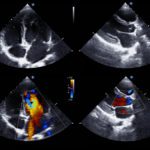
Large amount of anechoic free fluid is seen in the abdominal cavity with bowel loops floating in the fluid. The true nature of the free fluid can be accurately determined by performing an ultrasound guided paracentesis. Anteriorly, two reverberation artifacts are seen arising at the level of the parietal peritoneum.

Since air is lighter it tends to rise above and with the patient in the supine position it can be seen sonographically as an abdominal “a-line” pattern (reverberation artifact). This will move with change in patient position.
Normally, free air should not be seen inside the abdominal cavity unless a procedure was performed which could have introduced air into the peritoneal cavity or there is presence of gas forming from an organism infection. Air is normally seen with the bowel loops and it creates a “dirty shadow”. In this case the patient had Typhoid fever with perforation of the bowel. Exploratory laparotomy was performed, and the bowel perforation in the terminal ileum was surgically repaired. Fortunately, the patient recovered in 8 days and was discharged.
References
- Bomann, J.S., Van Tonder, R., Hernandez, S., Moore, C. Abdominal a-lines: a simpler sonographic sign of pneumoperitoneum? Crit Ultrasound J 3, 41–42. https://doi.org/10.1007/s13089-011-0054-7
Access the full POCUS Learning Library for FREE!
Share a few details so we can tailor new content to your specialty and region.